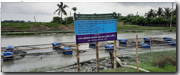
Feasibility of cage culture of Asian seabass in coastal rivers of Bangladesh
DOI:
https://doi.org/10.17017/j.fish.1124Keywords:
coastal rivers, Lates calcarifer, cage culture, stocking density, growth, feed, BangladeshAbstract
Despite its aquaculture potential, Asian seabass (Lates calcarifer) has not yet been adopted for cage culture in Bangladesh. This pilot study aimed to assess the feasibility of cage culture of this species in coastal rivers of Bangladesh. A total of six cages (18 m3 each) were installed in a coastal river and each was stocked with 50 fish (7.70 ± 0.18 g). Three feeding treatments were applied: 100% live feed (live and/or trashed juvenile tilapia) (T1); 50% live feed with 50% formulated feed (T2); and 100% formulated feed (T3). The experimental fish were reared for 12 weeks and fed at 8% of their body weight during the initial 3 weeks and at 6% during the later weeks. Fish refused formulated feed. Survival in T3 (64%) was significantly lower compared to that in T1 (88%) or T2 (82%) but did not differ between T1 and T2. Mean specific growth rates (SGR) were 1.66, 1.12, and 0.90 % d–1; daily growth rates (DGR) were 2.20, 0.74, and 0.44 g, and weight gain (WG) values were 182.50, 61.10, and 36.50 g in T1, T2, and T3, respectively. SGR values significantly differed among the treatments. DGR and WG values in T1 were significantly higher than that in T2 or T3 but did not differ between T2 and T3. Results indicate that cage culture of Asian seabass in Bangladesh requires live and/or trash fish as feed, or else advances in domestication and artificial feed development.
Downloads
References
Al Zahrani AW, Mohamed AH, Serrano Jr AE, Traifalgar RFM (2013) Effects of feeding rate and frequency on growth and feed utilization efficiency in the camouflage grouper (Epinephelus polyphekadion) fingerlings fed a commercial diet. European Journal of Experimental Biology 3(1): 596–601.
Anil MK, Santhosh B, Jasmine S, Saleela KN, George RM, … Rao GS (2010) Growth performance of the seabass Lates calcarifer (Blotch) in sea cage at Vizhinjam Bay along the south-west coast of India. Indian Journal of Fisheries 57(4): 65–69.
AOAC (2005) Official methods of analysis of the association of official analytical chemists international, 16th ed. Association of Official Analytical Chemists, Rockville, USA.
Ara MH, Uddin MN, Sarkar SC, Kumar U (2017) Seasonal variation of temperature dependent physico-chemical parameters of a coastal River Bhadra, Bangladesh. Journal of Tropical Biology and Conservation 14: 69–81.
Aswathy N, Joseph I (2019) Economic feasibility and resource use efficiency of coastal cage fish farming in Kerala. Economic Affairs 64(1): 151–155.
Boonyaratpalin M, Williams K (2002) Asian sea bass, Lates calcarifer. In: Webster CD, Lim C (Eds) Nutrient requirements and feeding of finfish for aquaculture. CABI Publishing, Wallingford, UK.
Carbone V, Shinn A, Crieloue H, van Amerongen A, Giri INA, … Debono S (2025) Adapting Mediterranean aquaculture larval feeding strategies for tropical species: a case study of barramundi. In: World Aquaculture–The Magazine of the World Aquaculture Society 56(1): 31.
Catacutan MR, Coloso RM (1997) Growth of juvenile Asian seabass, Lates calcarifer, fed varying carbohydrate and lipid levels. Aquaculture 149(1–2): 137–144.
Chudasama RV, Patel PH, Bhola GK, Zala NA, Devaliya JD (2023) A short review of Asian seabass (Lates calcarifer) cultivation. Indian Journal of Pure and Applied Biosciences 11(3): 17–35.
Debnath D, Pal AK, Sahu NP, Jain KK, Yengkokpam S, Mukherjee SC (2005) Effect of dietary microbial phytase supplementation on growth and nutrient digestibility of Pangasius pangasius (Hamilton) fingerlings. Aquaculture Research 36(2): 180–187.
Dey BK, Hossain MMM, Alam ME (2020) Effect of black cumin seed oil on growth, innate immunity and resistance against Pseudomonas fluorescens infection in Nile tilapia Oreochromis niloticus. Aquaculture International 28(4): 1485–1499.
Dunstan DJ (1959) The barramundi Lates calcarifer (Bloch) in Queensland waters. Technical Paper (CSIRO, Division of Fisheries and Oceanography, Australia) 5: 22.
FAO (2025) FishStatJ–software for fishery and aquaculture statistical time series. Food and Agriculture Organization of the United Nations, Rome, Italy.
Gomez KA, Gomez AA (1984) Statistical procedures for agricultural research. John Wiley & Sons, New York, USA.
Hassan HU, Ali QM, Ahmad N, Masood Z, Hossain MY, … Kamal M (2021) Assessment of growth characteristics, the survival rate and body composition of Asian seabass Lates calcarifer (Bloch, 1790) under different feeding rates in closed aquaculture system. Saudi Journal of Biological Sciences 28(2): 1324–1330.
Hassan HU, Ali QM, Siddique MAM, Hasan MR, Hossain MY (2022) Effects of dietary protein levels on growth, nutritional utilization, carcass composition and survival of Asian seabass Lates calcarifer (Bloch, 1790) fingerlings rearing in net cages. Thalassas: An International Journal of Marine Sciences 38(1): 21–27.
Ignatius B (2016) Equipping fisherwomen youth for the future. In: Manual of ICAR-Central marine Fisheries Research Institute, Cochin, India. pp. 175–178.
Ilham I, Siddik MAB, Fotedar R (2016) Effects of organic selenium supplementation on growth, accumulation, haematology and histopathology of juvenile barramundi (Lates calcarifer) fed high soybean meal diets. Biological Trace Element Research 174: 436–447.
Islam MM, Azad AK, Ara MH, Rahman M, Hassan N, … Rabeya I (2016) Environmental study on a coastal river of Bangladesh with reference to irrigation water quality assessment: a case study on Shailmari River, Khulna. Journal of Geoscience and Environment Protection 4(10): 41–64.
Kailasam M, Chandra PK, Muralidhar M, Thirunavukkarasu AR, Abraham M (2001) Survival and growth of seabass, Lates calcarifer (Bloch) fry reared at different stocking densities. In: Perspectives in Mariculture, Marine Biological Association of India, Kochi, India. pp. 311–320.
Khan MSK, Salin KR, Yakupitiyage A, Siddique MAM (2021) Effect of stocking densities on the growth performance, cannibalism and survival of Asian seabass Lates calcarifer (Bloch, 1790) fry in different nursery rearing system. Aquaculture Research 52(11): 5332–5339.
Köprücü K, Yonar SM, Köprücü S, Yonar ME (2024) Effect of different stocking densities on growth, oxidative stress, antioxidant enzymes, and hematological and immunological values of European catfish (Silurus glanis L., 1758). Aquaculture International 32(3): 2957–2973.
Krishna S, Thirunavukkarasu AR, Kailasam M, Prem K, Subburaj R, Thiagarajan G (2014) Pre-growout culture of Asian seabass (Lates calcarifer) (Bloch) in low volume cage in brackishwater Ashtamudi lake under participatory mode with traditional fishermen. Journal of Aquatic Biology and Fisheries 2: 272–276.
Kumaran M, Vasagam KPK, Kailasam M, Subburaj R, Anand PR, … Vijayan KK (2021) Three-tier cage aquaculture of Asian seabass (Lates calcarifer) fish in the coastal brackishwaters–A techno-economic appraisal. Aquaculture 543: 737025.
Kungvankij P, Tiro Jr LB, Pudadera Jr BJ, Potestas IO (1986) Biology and culture of sea bass (Lates calcarifer). In: Aquaculture extension manual, No. 11, Network of Aquaculture Centres in Asia-Pacific, Bangkok, Thailand.
Manju Lekshmi N (2015) Coastal aquaculture a potential livelihood opportunity for Goa with special reference to mussel culture (pp. 89–90). In: Souvenir-silver jubilee publication, ICAR-Research complex for Goa, Goa, India.
Mitra R, Sikder V (2023) Impact of brackish water aquaculture and mangrove degradation on global carbon balance: a review. The Holistic Approach to Environment 13(2): 76–82.
Pervin T, Yeasmin S, Islam R, Rahman A, Sattar A (2013) Studies on nutritional composition and characterization of lipids of Lates calcarifer (Bhetki). Bangladesh Journal of Scientific and Industrial Research 47(4): 393–400.
Philipose KK, Sharma SRK, Loka J, Sadhu N, Divu D, Dube P (2013) Culture of Asian seabass (Lates calcarifer, Bloch) in open sea floating net cages off Karwar, South India. Indian Journal of Fisheries 60(1): 67–70.
Rimmer MA, Russell DJ (1998) Aspects of the biology and culture of Lates calcarifer. In: De Silava SS (Ed) Tropical Mariculture. Academic Press, Cambridge, USA. pp. 449–476.
Salama AJ, Al-Harbi MA (2007) Response of the Asian seabass Lates calcarifer fingerlings to different feeding rates and feeding frequencies reared in hyper saline condition. Marine Sciences 18(1): 1–18.
Sangeeta K, Tiwari VK, Rani AMB, Rajesh K, Satya P (2018) Effect of feeding rate on growth, survival and cannibalism in striped snakehead Channa striata (Bloch, 1793) fingerlings. Journal of Experimental Zoology India 21(1): 205–210.
Santos GA, Schrama JW, Mamauag REP, Rombout JHWM, Verreth JAJ (2010) Chronic stress impairs performance, energy metabolism and welfare indicators in European seabass (Dicentrarchus labrax): the combined effects of fish crowding and water quality deterioration. Aquaculture 299(1–4): 73–80.
Singh RK (2000) Growth, survival and production of Lates calcarifer in a seasonal rain-fed coastal pond of the Konkan region. Journal of Aquaculture 8: 55–60.
Tiensongrusmee B, Chantarasri S, Budileksono S, Yuwono SK, Santoso H (1989) Propagation of seabass, Lates calcarifer in captivity. (accessed on 24 November 2025).
Tucker Jr, Russel DJ, Rimmer MA (2002) Barramundi culture: a success story for aquaculture in Asia and Australia. World Aquaculture 33(3): 53–59.
Vij S, Purushothaman K, Gopikrishna G, Lau D, Saju JM, … Orbán L (2014) Barcoding of Asian seabass across its geographic range provides evidence for its bifurcation into two distinct species. Frontiers in Marine Science 1: 1–30.
Water Resources Planning Organization (WARPO) (2019) Research on the morphological processes under climate changes, sea level rise and anthropogenic intervention in the coastal zone. Ministry of Water Resources, Government of the People’s Republic of Bangladesh. pp. 1–77.
Yenmak S, Joerakate W, Poompuang S (2018) Prediction of fillet yield in hatchery populations of Asian seabass, Lates calcarifer (Bloch, 1790) using body weight and measurements. International Aquatic Research 10(3): 253–261.