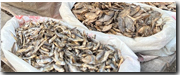
Socio-economic assessment of dry fish processors in Cuddalore District, Tamil Nadu, India
DOI:
https://doi.org/10.17017/j.fish.1230Keywords:
Cuddalore, dry fish processing, livelihood resilience, socio-economic profile, Tamil Nadu, women processorsAbstract
The present study focuses on the socio-economic characteristics and occupational structure of dry fish processors in the Cuddalore District of Tamil Nadu, India. The primary data was collected from 100 dry fish processors in Cuddalore (50%) and Parangipettai (50%) blocks of the district in 2025 using a structured interview schedule. It was found that the sector was mostly women-dominated (87%) and 66% of respondents were above 45 years. Dry fish processing was the main occupation for 82% of the respondents. Most of the respondents belonged to nuclear families (74%) with 3–5 members. Raw fish procurement was mostly dependent on landing centers (67%), and traditional cement floor drying (54%) was predominant. Credit dependence was reported by 61% of the respondents, mostly from non-institutional sources (62%). Garrett ranking revealed that raw fish scarcity (Garrett mean score: 71.69) and weather uncertainty (Garrett mean score: 67.80) were the key constraints. A statistically significant association was observed between village location and production quality preference (χ² = 15.458; p < 0.05). The study concluded that the dry fish processing sector was an economically important but structurally vulnerable component of the marine fisheries value chain, which requires better institutional support and technological assistance to improve livelihood stability.
Downloads
References
Akintola SL, Fakoya KA (2017) Small-scale fisheries in the context of traditional post-harvest practice and the quest for food and nutritional security in Nigeria. Agriculture and Food Security 6: 34.
Allison EH, Ellis F (2001) The livelihoods approach and management of small-scale fisheries. Marine Policy 25(5): 377–388.
Arthur RI, Skerritt DJ, Schuhbauer A, Ebrahim N, Friend RM, Sumaila UR (2022) Small-scale fisheries and local food systems: transformations, threats and opportunities. Fish and Fisheries 23(1): 109–124.
Belton B, Bush SR, Little DC (2018) Not just for the wealthy: rethinking farmed fish consumption in the global South. Global Food Security 16: 85–92.
Béné C, Neiland A, Jolley T, Ovie S, Sule O, … Quensière J (2003) Inland fisheries, poverty, and rural livelihoods in the Lake Chad Basin. Journal of Asian and African Studies 38(1): 17–51.
Clucas IJ, Ward AR (1996) Post-harvest fisheries development: a guide to handling, preservation, processing and quality. Natural Resources Institute, Chatham, UK.
CMFRI (2023) Annual report 2022–23. Central Marine Fisheries Research Institute, Kochi, India.
FAO (2020) The state of world fisheries and aquaculture 2020 – sustainability in action. Rome, Italy.
FAO (2022) The state of world fisheries and aquaculture 2022 – towards Blue Transformation. Rome, FAO.
FAO (2023) The state of world fisheries and aquaculture 2023 – revealing the true cost of food to transform agrifood systems. Rome.
Flowra FA, Sen SC, Galib SM, Kamal MM, Islam SN (2010) Dry fish marketing in Rajshahi and Thakurgaon, Bangladesh. International Journal of BioResearch 1(5): 13–16.
Garrett HE, Woodworth RS (1973) Statistics in psychology and education. Vakils, Feffer and Simons Private Ltd, Bombay, India.
Gaugh HG (1992) Statistical analysis of regional yield trials: AMMI analysis of factorial designs. Elsevier, Amsterdam, Netherlands.
Harper S, Zeller D, Hauzer M, Pauly D, Sumaila UR (2013) Women and fisheries: contribution to food security and local economies. Marine Policy 39: 56–63.
Immaculate K, Sinduja P, Velammal A, Patterson J (2013) Quality and shelf life status of salted and sun dried fishes of Tuticorin fishing villages in different seasons. International Food Research Journal 20(4): 1855–1863.
Kanthimathinathan S, Morais FR (2017) An analysis of economic impact of fish processing on women workers in Thoothukudi District. OUTREACH X: 13–22.
Kashyap D, Devi R, Phukan B, Baishya S, Dutta MP, … Hussain IA (2013) Marketing efficiency across the marketing channels in dry fish business in North East India. Environment and Ecology 31(4): 1732–1735.
Mahish PK (2015) Traditional fish processing and economic status of fishermen of Central India with special reference to Rajnandgaon, Chhattisgarh, India. International Research Journal of Biological Sciences 4(9): 33–42.
Narayanakumar R, Sathiadhas R (2005) Economics of marine fish marketing in India. Indian Journal of Fisheries 52(3): 297–306.
Narayanakumar R, Sathiadhas R (2005) Marine fish marketing in India. Indian Journal of Fisheries 52(3): 297–306.
Pandey S, Zechariah J (2024) Socioeconomic index and marketing channel of dry fish in Puri district, Odisha. Agri Express 2(01).
Pomeroy R, Arango C, Lomboy CG, Box S (2020) Financial inclusion to build economic resilience in small-scale fisheries. Marine Policy 118: 103982.
Salagrama V (2012) Climate change and fisheries: perspectives from small-scale fishing communities in India on measures to protect life and livelihood. International Collective in Support of Fishworkers, Chennai, India.
Samad MA, Galib SM, Flowra FA (2009) Fish drying in Chalan Beel areas. Bangladesh Journal of Scientific and Industrial Research 44(4): 461–466.
Senevirathne MMSC, De Silva DAM, Esham M (2025) Informal financing mechanisms adopted by female small-scale fish processors in the face of climate change impacts in Sri Lanka. In: Dissanayake R, Mendis P, De Silva S, Fernando S, Attanayake U, Gajanayake P (Eds) Proceedings of the 15th International Conference on Sustainable Built Environment (ICSBE 2024). Lecture Notes in Civil Engineering, vol 652. Springer, Singapore, pp 345–356.
Singh A, Sahoo PK, Srinath K, Kumar A, Tanuja S, ... Nanda R (2014) Gender roles and livelihood analysis of women in dry fish processing: a study in coastal Odisha. Fishery Technology 51(4): 267–273.
Syda Rao G, Sathianandan TV, Kuriakose S, Mini KG, Najmudeen TM, ... Mathew WT (2016) Demographic and socio-economic changes in the coastal fishing community of India. Indian Journal of Fisheries 63(4): 1–9.
Weeratunge N, Snyder K (2010) Gleaner, fisher, trader, processor: understanding gendered employment in fisheries and aquaculture. Fish and Fisheries 11(4): 405–420.