
Identification of yellowtail snapper, Ocyurus chrysurus (Bloch, 1791), stocks using otolith shape analysis in the coastal waters of northeastern Brazil
DOI:
https://doi.org/10.17017/j.fish.1087Keywords:
morphometrics, Ocyurus chrysurus, otoliths, shape index, yellowtail snapper, wavelet coefficientsAbstract
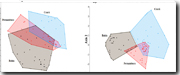
Otoliths, which grow continuously throughout a fish's life, play a crucial role in identifying fish stocks. This study aimed to distinguish stocks of Ocyurus chrysurus (Bloch, 1791) in the coastal waters of northeastern Brazil using otolith morphology. Otolith morphology was examined in specimens collected from three regions (Ceará, Pernambuco and Bahia) of northeastern Brazil using morphometric parameters, shape indices, and wavelet coefficients. The results revealed significant differences in otolith morphology between Bahia and the other two regions. Classification based on morphometric parameters and shape indices correctly assigned 43%, 45%, and 87% of specimens from Ceará, Pernambuco, and Bahia, respectively. Wavelet coefficients further improved classification accuracy to 45%, 48%, and 98%, respectively. Mean otolith outlines showed marked regional differences, particularly in the rostrum (0–40o and 320–360o) and post-rostrum (145–200o) regions. These findings provide valuable information for stock discrimination and support fisheries management of O. chrysurus along the northeastern coast of Brazil.
Downloads
References
Agüera A, Brophy D (2011) Use of sagittal otolith shape analysis to discriminate northeast Atlantic and western Mediterranean stocks of Atlantic saury, Scomberesox saurus saurus (Walbaum). Fisheries Research 110: 465–471.
Araújo JND, Martens AS, Costa KGD (2002) Age and growth of yellowtail snapper, Ocyurus chrysurus, from the Central Coast of Brazil. Brazilian Journal of Oceanography 50: 47–57.
Aschenbrenner A, Ferreira BP, Rooker JR (2016) Spatial and temporal variability in the otolith chemistry of the Brazilian snapper Lutjanus alexandrei from estuarine and coastal environments. Journal of Fish Biology 89: 753–769.
Avigliano E, Velasco G, Volpedo AV (2015) Use of lapillus otolith microchemistry as an indicator of the habitat of Genidens barbus from different estuarine environments in the southwestern Atlantic Ocean. Environmental Biology of Fishes 98: 1623–1632.
Bartlett MS (1954) A note on the multiplying factors for various chi-square approximations. Journal of the Royal Statistical Society 16: 296–298.
Begossi A, Salivonchyk SV, Araujo LG (2011) Ethnobiology of snappers (Lutjanidae): target species and suggestions for management. Journal of Ethnobiology and Ethnomedicine 7: 1–23.
Bourel M, Segura AM (2018) Multiclass classification methods in ecology. Ecological Indicator 85: 1012–1021.
Campana SE, Casselman JM (1993) Stock discrimination using otolith shape analysis. Canadian Journal of Fisheries and Aquatic Sciences 50: 1062–1083.
Claro R, Lindeman KC (2003) Spawning aggregation sites of snapper and grouper species (Lutjanidae and Serranidae) on the insular shelf of Cuba. Gulf and Caribbean Research 14: 91–106.
Claro R, Lindeman KC (2008) Biología y manejo de los pargos (Lutjanidae) en el Atlántico occidental. La Habana: Instituto de Oceanología, CITMA. 472 pp. (in Spanish).
Correia AT, Barros F, Sial AN (2011) Stock discrimination of European conger eel (Conger conger L.) using otoliths stable isotope ratios. Fisheries Research 108: 88–94.
da Silva R, Sampaio I, Schneider H, Gomes G (2016) Lack of spatial subdivision for the snapper Lutjanus purpureus (Lutjanidae–Perciformes) from Southwest Atlantic based on multi-locus analyses. PLOS ONE 11(8): e0161617.
da Silva R, Veneza I, Sampaio I, Araripe J, Schneider H, Gomes G (2015) High levels of genetic connectivity among populations of yellowtail snapper, Ocyurus chrysurus (Lutjanidae–Perciformes), in the western south Atlantic revealed through multilocus analysis. PLoS One 10: e0122173.
da Silva R, Veneza I, Sampaio I, Araripe J, Schneider H, Gomes G (2015) High levels of genetic connectivity among populations of yellowtail snapper, Ocyurus chrysurus (Lutjanidae–Perciformes), in the Western South Atlantic revealed through multilocus analysis. PLOS ONE 10(3): e0122173.
Di Franco A, Bulleri F, Pennetta A, De Benedetto G, Clarke KR, Guidetti P (2014) Within-otolith variability in chemical fingerprints: implications for sampling designs and possible environmental interpretation. PLoS One 9(7): e101701.
Domeier ML, Colin PL (1997) Tropical reef fish spawning aggregations: defined and reviewed. Bulletin of Marine Science 60(3): 698–726.
Duarte-Neto P, Lessa R, Stosic B, Morize E (2008) The use of sagittal otoliths in discriminating stocks of common dolphinfish (Coryphaena hippurus) off northeastern Brazil using multishape descriptors. ICES Journal of Marine Sciences 65(7): 1144–1152.
Everitt BS, Dunn G (1991) Applied multivariate data analysis. Edward Arnold, London.
Feitoza BM, Rosa RS, Rocha LA (2005) Ecology and zoogeography of deep reef fishes in northeastern Brazil. Bulletin of Marine Science 76(3): 725–742.
Fonteles-Filho AA (1969) Estudo preliminar sobre a pesca do pargo, Lutjanus purpureus Poey, no Nordeste brasileiro. Arq. Ciên. Mar 9: 83–88.
Geladakis G, Batargias C, Somarakis S, Koumoundouros G (2023) Stock discrimination of gilthead seabream (Sparus aurata Linnaeus, 1758) through the examination of otolith morphology and genetic structure. Fishes 8(6): 291.
Hawkins SJ, Bohn K, Sims DW, Ribeiro P, Faria J, … Genner MJ (2016) Fisheries stocks from an ecological perspective: disentangling ecological connectivity from genetic interchange. Fisheries Research 179: 333–341.
Jackson DA (1993) Stopping rules in principal component analysis: a comparison of heuristical and statistical approaches. Ecology 74: 2204–2214.
Kaiser HF (1974) An index of factorial simplicity. Psychometrika 39: 31–36.
Krajewski JP, Bonaldo RM (2005) Spawning out of aggregations: record of a single spawning dog snapper pair at Fernando de Noronha Archipelago, Equatorial Western Atlantic. Bulletin of Marine Science 77: 165–168.
Leão ZMDAN, Dominguez JML (2000) Tropical coast of Brazil. Marine Pollution Bulletin 41(1): 112–122.
Libungan LA, Pálsson S (2015) ShapeR: an R package to study otolith shape variation among fish populations. PLoS One 10: e0121102.
Lleonart J, Salat J, Torres GJ (2000) Removing allometric effects of body size in morphological analysis. Journal of Theoretical Biology 205(1): 85–93.
Longo GO, Morais RA, Martins CDL, Mendes TC, Aued AW, … Floeter SR (2015) Between-habitat variation of benthic cover, reef fish assemblage and feeding pressure on the benthos at the only atoll in South Atlantic: Rocas Atoll, NE Brazil. PLoS One 10(6): e0127176.
Mounir A, Hichami N, Chouikh NE, Ouknin M, Alahyane A, Alahyane H (2023) Evaluation of otolith shape as an approach for stock discrimination of Sardina pilchardus off the Moroccan Atlantic coast. Egyptian Journal of Aquatic Biology and Fisheries 27(3): 573–588.
Moura RL, Francini-Filho RB, Chaves EM, Minte-Vera CV, Lindeman KC (2011) Use of riverine through reef habitat systems by dog snapper (Lutjanus jocu) in eastern Brazil. Estuarine and Coastal Shelf Science 95(1): 274–278.
Ortiz-Lozano L, Pérez-España H, Granados-Barba A, González-Gándara C, Gutiérrez-Velázquez A, Martos J (2013) The reef corridor of the southwest Gulf of Mexico: challenges for its management and conservation. Ocean and Coastal Management 86: 22–32.
Özpiçak M, Saygın S, Yılmaz S (2024) Comparative otolith morphology in two species of Salmo genus from Türkiye. Ege Journal of Fisheries and Aquatic Sciences 41(1): 8–15.
Park JM, Kang MG, Kim JH, Jawad LA, Majeed S (2023) Otolith morphology as a tool for stock discrimination of three rockfish species in the East Sea of Korea. Frontiers in Marine Science 10: 1240972.
Pereira-Filho GH, Shintate GS, Kitahara MV, Moura RL, Amado-Filho GM, … Motta FS (2019) The southernmost Atlantic coral reef is off the subtropical island of Queimada Grande (24°S), Brazil. Bulletin of Marine Science 95: 277–287.
Previero M, Gasalla MA (2020) Risk assessment of small‐scale reef fisheries off the Abrolhos Bank: snappers and groupers under a multidimensional evaluation. Fisheries Management and Ecology 27: 231–247.
Qiao J, Zhu R, Chen K, Zhang D, Yan Y, He D (2022) Comparative otolith morphology of two morphs of Schizopygopsis thermalis Herzenstein 1891 (Pisces, Cyprinidae) in a headwater lake on the Qinghai-Tibet Plateau. Fishes 7(3): 99.
R Core Team (2025) R: a language and environment for statistical computing. R Foundation for Statistical Computing, Vienna, Austria.
Rahnama B, Raeisi H, Francini-Filho R, Rosa RS (2023) The use of different otolith-shape analyses for stock discrimination of yellowtail snapper Ocyurus chrysurus (Bloch, 1791) in the coastal waters of northeastern Brazil. International Journal of Aquatic Biology 11(6): 490–504.
Rezende SM, Ferreira BP, Fredou T (2003) A pesca de lutjanídeos no nordeste do Brasil: histórico das pescarias, características das espécies e relevância para o manejo. Boletim Técnico-Científico do CEPENE 11: 257–270¬.
Ripley B (2020) MASS: support functions and datasets for Venables and Ripley's MASS. R package version 7.3-52.
Sedighzadeh Z, Valinassab T, Vossoughi G, Motallebi A, Fatemi MR, … Tuset VM (2014) Use of otolith shape for stock identification of John’s snapper, Lutjanus johnii (Pisces: Lutjanidae), from the Persian Gulf and the Oman Sea. Fisheries Research 155: 59–63.
Silva DC, Martins K, Oliveira J, da Silva R, Sampaio I, ... Gomes G (2018) Genetic differentiation in populations of lane snapper (Lutjanus synagris–Lutjanidae) from Western Atlantic as revealed by multilocus analysis. Fisheries Research 198: 138–149.
Soeth M, Spach HL, Daros FA, Adelir-Alves J, Almeida ACO, Correia AT (2019) Stock structure of Atlantic spadefish Chaetodipterus faber from the Southwest Atlantic Ocean inferred from otolith elemental and shape signatures. Fisheries Research 211: 81–90.
Souza ASD, Dias Junior EA, Perez MF, Cioffi MB, Bertollo LAC, … Molina WF (2019) Phylogeography and historical demography of two sympatric Atlantic snappers: Lutjanus analis and L. jocu. Frontiers in Marine Science 6: 545.
Stransky C (2014) Morphometric outlines (pp. 129–140). In: Cadrin SX, Kerr LA, Mariani S (Eds) Stock identification methods: applications in fishery science, second edition. Academic Press.
Taillebois L, Barton DP, Crook DA, Saunders T, Taylor J, ... Ovenden JR (2017) Strong population structure deduced from genetics, otolith chemistry and parasite abundances explains vulnerability to localized fishery collapse in a large sciaenid fish, Protonibea diacanthus. Evolutionary Applications 10(10): 978–993.
Tuset VM, Rosin PL, Lombarte A (2006) Sagittal otolith shape used in the identification of fishes of the genus Serranus. Fisheries Research 81: 316–325.
Vaz A, Guerreiro MA, Landa J, Hannipoula O, Thasitis I, … Martinho F (2023) Otolith shape analysis as a tool for stock identification of two commercially important marine fishes: Helicolenus dactylopterus and Merluccius merluccius. Estuarine Coastal and Shelf Science 293: 108471.
Wang X, Wang L, Shaoliang LV, Teng LI (2018) Stock discrimination and connectivity assessment of yellowfin seabream (Acanthopagrus latus) in northern South China Sea using otolith elemental fingerprints. Saudi Journal of Biological Sciences 25: 1163–1169.
Wiff R, Flores A, Segura AM, Barrientos MA, Ojeda V (2020) Otolith shape as a stock discrimination tool for ling (Genypterus blacodes) in the fjords of Chilean Patagonia. New Zealand Journal of Marine and Freshwater Research 54: 218–232.
Zhou Y, Xu L, He Z, Cui W, Lu Q, … He T (2023) Discrimination of Schizothorax grahami (Regan, 1904) stocks based on otolith morphology. Fishes 8(10): 504.
Downloads
Published
Data Availability Statement
The data that support the findings of this study are avail-able on a reasonable request from the corresponding author.
Issue
Section
License
Copyright (c) 2026 Eisa Hajiradkouchak, Behzad Rahnama, Mehdi Khoshnamvand, Ricardo Souza Rosa

This work is licensed under a Creative Commons Attribution-NonCommercial-ShareAlike 4.0 International License.